The short answer
If your flight left from an airport where winter is normal and you landed more than three hours late because the aircraft had to be de-iced, you are probably owed compensation — €250 to €600 under EU261, or £220 to £520 under UK261.
Airlines deny these claims by invoking "extraordinary circumstances," the escape hatch in the regulation that removes their obligation to pay. Their argument is that snow is weather, and weather is outside their control.
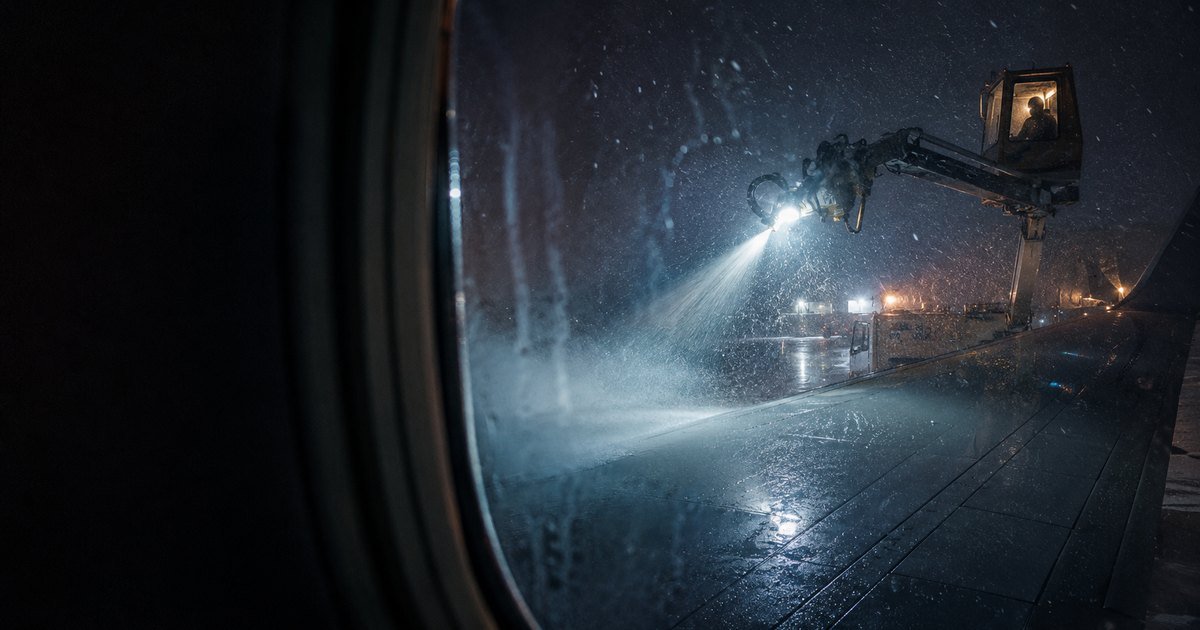
Germany's Federal Court of Justice rejected that argument. In case X ZR 146/23, the court held that de-icing an aircraft is part of an airline's normal operational activity in winter conditions — not an extraordinary event. Snow in January is not a surprise. Planning for it is the airline's job.
What the court actually decided
The case involved a passenger flying Minneapolis to Düsseldorf via Amsterdam on KLM in December 2021. The aircraft was de-iced in Minneapolis, departed late, and the passenger missed the onward connection.
KLM argued extraordinary circumstances. The court disagreed, and the reasoning is what matters for your own claim:
De-icing is foreseeable. An airline scheduling a December departure from a cold-weather airport knows de-icing is likely. Foreseeable, seasonal events are part of running an airline, not exceptional interruptions to it.
The location test. The ruling applies "in any case to regions where winter temperatures are to be expected." Minneapolis in December qualifies. So do Munich, Oslo, Chicago, Toronto, Zurich and Denver.
Normal risk is the airline's risk. If de-icing capacity at a hub is insufficient to handle a routine snowfall, that is an operational shortfall — and operational shortfalls are compensable.
The practical effect: the standard denial letter you receive is frequently indefensible. Most passengers accept it anyway, which is precisely why airlines keep sending it.
When snow genuinely is extraordinary
This cuts both ways, and it is worth being honest about where the line sits — a claim that ignores it will simply be rejected.
Likely compensable: routine de-icing at a cold-climate airport in winter. A snowfall the airport handles every year. Insufficient de-icing trucks or fluid at a hub that should be prepared.
Likely not compensable: an airport shutdown ordered by air traffic control. A genuinely exceptional storm well outside the seasonal norm — freezing conditions in Lisbon or Athens, where no reasonable operator maintains full winter capacity. Runway closures affecting all carriers equally.
The test is not "was there weather." It is "should this airline, at this airport, in this month, have been ready for this." If the answer is yes, weather is not a defence.
What you are owed, by regulation
EU261 — applies to flights departing any EU airport, and to flights arriving in the EU on an EU carrier. Compensation is set by distance:
- Under 1,500 km: €250 (3+ hours late)
- 1,500 to 3,500 km: €400 (3+ hours late)
- Over 3,500 km: €600 (4+ hours late)
UK261 — the post-Brexit mirror of the same rules, in sterling: £220 up to 932 miles, £350 for 932 to 2,175 miles, £520 beyond 2,175 miles.
United States — there is no federal right to cash compensation for a delay, weather or otherwise. If your flight operates three hours late, no US rule entitles you to a payment. DOT rules cover refunds for cancellations and significant delays, not compensation on top.
That asymmetry matters for routing. A delayed departure from Frankfurt carries a €600 exposure for the airline. The same delay departing Chicago on a domestic ticket carries none. It is one more reason a European connection is worth more than it looks on a fare comparison.
How to claim without paying a middleman
Claim companies take 25 to 35 percent of the payout. For a €600 claim that is up to €210 for filing a form. Go direct first.
1. Document the delay before you leave the airport. Photograph the departure board showing the delay, keep your boarding pass, and note the actual arrival time at your final destination — arrival time is what the regulation measures, not departure.
2. Write to the airline in plain terms. State the flight number, date, arrival delay, and that you are claiming under Regulation 261/2004. If they cite de-icing, reference the reasoning above: de-icing at a winter-climate airport is normal operational activity.
3. Escalate when they refuse. In the EU, complain to the national enforcement body of the departure country. In the UK, go to the CAA or an approved ADR scheme. Both are free.
4. Only then consider a claim firm. If the airline stonewalls and you would rather have 70 percent of something than 100 percent of nothing, that is a reasonable trade — but not as your opening move.
One practical note: you have years, not days. Limitation periods run from two to six years depending on the country. A delay from last winter is very likely still claimable.
While you wait it out
A de-icing delay usually means a long sit at the gate, then a scramble at the other end. Two things make that materially better.
If the delay pushes past a couple of hours, a lounge day pass buys you a seat, food, and power without a membership — see [how to get one for a single flight](/blog/airport-lounge-day-pass-without-membership). If the delay kills your connection entirely, the decision changes completely and speed matters: [what to do in the first twenty minutes](/blog/flight-cancelled-snowstorm-what-to-do-first).
And if you want to understand why you are still sitting there after the spraying finished, that has a specific technical answer: [holdover time](/blog/why-plane-still-sitting-after-de-icing-holdover-time).
Frequently Asked Questions
Can I get compensation if my flight was delayed by de-icing?
Usually yes, if you arrived more than three hours late from an airport where winter conditions are normal. Germany's Federal Court of Justice ruled in case X ZR 146/23 that de-icing is part of an airline's normal winter operations, not an extraordinary circumstance — so the standard weather denial does not hold.
How much is de-icing delay compensation worth?
Under EU261: €250 for flights under 1,500 km, €400 for 1,500 to 3,500 km, and €600 above 3,500 km. Under UK261: £220, £350 and £520 across equivalent distance bands. The delay is measured at arrival, not departure.
Does this apply to flights in the United States?
No. There is no US federal rule requiring cash compensation for delays. DOT rules require refunds for cancellations and significant delays, but not compensation on top. EU261 can still apply to a US departure if you are flying to the EU on an EU carrier.
Is it too late to claim for a flight from last winter?
Almost certainly not. Limitation periods range from two to six years depending on the country whose courts apply — six years in the UK, three in Germany. A delay from one or two winters ago is generally still within time.
Travel Essentials We Recommend
As an Amazon Associate, we earn from qualifying purchases at no extra cost to you.

Anker PowerCore 10000 Portable Charger
Ultra-compact 10,000mAh power bank. Charge your phone 2-3 times — a lifesaver during long layovers when airport outlets are taken.

Sony WH-1000XM5 Premium Noise Canceling Headphones
Industry-leading noise cancellation with 30-hour battery. Perfect for long-haul flights, noisy terminals, and focused work at airport hotels.
Ready to Book Your Stay?
Compare Frankfurt airport hotel rates and book top-rated tours & transfers.
Or read our curated Frankfurt airport hotel guide